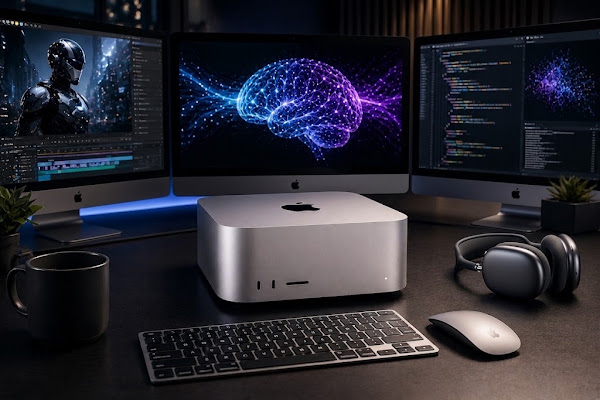

The Mac Studio with M5 Ultra delivers up to 4.3x faster peak AI compute performance than M3 Ultra and up to 1.8x faster graphics. With GPU Neural Accelerators, up to 512GB of unified memory, and 1.2TB/s memory bandwidth, it can run large AI models and demanding creative workflows directly on-device.
High-end digital workflows demand unprecedented local processing power, especially as complex generative AI models and real-time 3D rendering become standard office tools. Apple addressed these needs by launching its updated compact desktop workstation equipped with next-generation custom silicon. If you’re a video editor, developer, or AI researcher, Apple’s latest Mac Studio packs enough raw power to make you rethink whether you even need cloud servers anymore.
By combining updated CPU architecture, GPU-integrated Neural Accelerators, and expanded memory bandwidth, the hardware shifts how resource-heavy operations run locally. Rather than relying on cloud data centers, professionals can now handle large language models (LLMs) and massive video timelines directly from their desks.
Key Takeaways
- Unprecedented Local AI Compute: The M5 Ultra chip delivers up to 4.3x faster peak AI performance compared to M3 Ultra, enabling large language models to run completely on-device.
- Massive Unified Memory: Configurations offer up to 512GB of unified memory with 1.2TB/s memory bandwidth, eliminating bottlenecks during heavy multitasking and data processing.
- Pro Connectivity Expansion: Equipped with Thunderbolt 5 ports reaching up to 120Gb/s transfer speeds, alongside initial Mac Studio support for Wi-Fi 7 and Bluetooth 6.
- Clustering Capabilities: Built-in Thunderbolt 5 and RDMA allow users to link multiple Mac Studio units together, boosting AI inference speeds up to 3x over a single unit.
Silicon Architecture: M5 Max vs. M5 Ultra
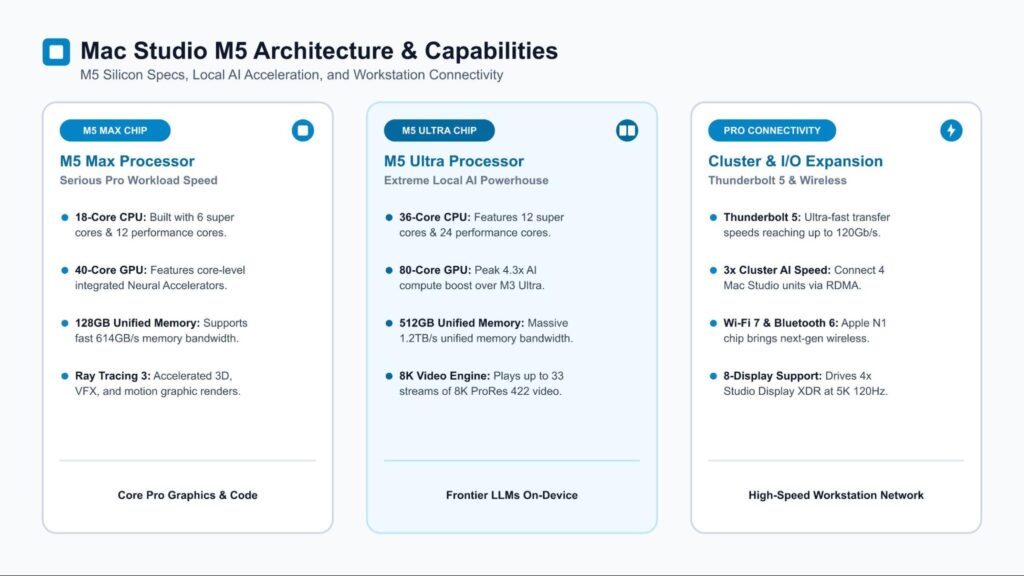
The foundation of the workstation lies in the M5 Max and M5 Ultra processors. Both chips integrate Neural Accelerators directly into the GPU cores, accelerating matrix multiplication tasks essential for modern artificial intelligence workflows.
M5 Max Performance Profile
Engineered for software developers, video editors, and 3D designers, the M5 Max configuration features an 18-core CPU alongside an up-to-40-core GPU. It supports up to 128GB of unified memory with a bandwidth of 614GB/s. Third-generation hardware-accelerated ray tracing and enhanced shader cores allow smoother navigation in complex 3D environments and faster offline rendering.
M5 Ultra Scaling
The M5 Ultra doubles down by fusing two M5 Max chips together. The result? A staggering 36 CPU cores, an 80-core GPU, and up to 512GB of unified memory operating at 1.2TB/s. That gives you enough headroom to run massive, unquantized LLMs right from your desk. Plus, with double the video encode and decode engines of the M5 Max, filmmakers can play back up to 33 simultaneous streams of 8K ProRes 422 video without breaking a sweat.
Real-World Benchmarks and On-Device AI
Running AI locally is the real headliner here. Skipping cloud APIs means no token limits, lower latency, better privacy, and zero monthly API bills.
| Benchmark Category | M5 Max vs. Previous Chips | M5 Ultra vs. Previous Chips |
| LLM Prompt Processing | 3.9x faster than M4 Max (10.7x vs M1 Max) | 4x faster than M3 Ultra (9.8x vs M1 Ultra) |
| Text-to-Image Generation | 3.5x faster than M4 Max | 4.3x faster than M3 Ultra |
| 3D / VFX Scene Rendering | 1.4x faster in Maxon Redshift vs M4 Max | 1.7x faster in Maxon Redshift vs M3 Ultra |
| ML Model Training | 3x faster DaVinci Resolve Magic Mask vs M4 Max | 3.3x faster CopyCat ML training in Nuke vs M3 Ultra |
Video editors using software such as Blackmagic Design DaVinci Resolve experience up to 3x faster Magic Mask processing on the M5 Max compared to previous generations.
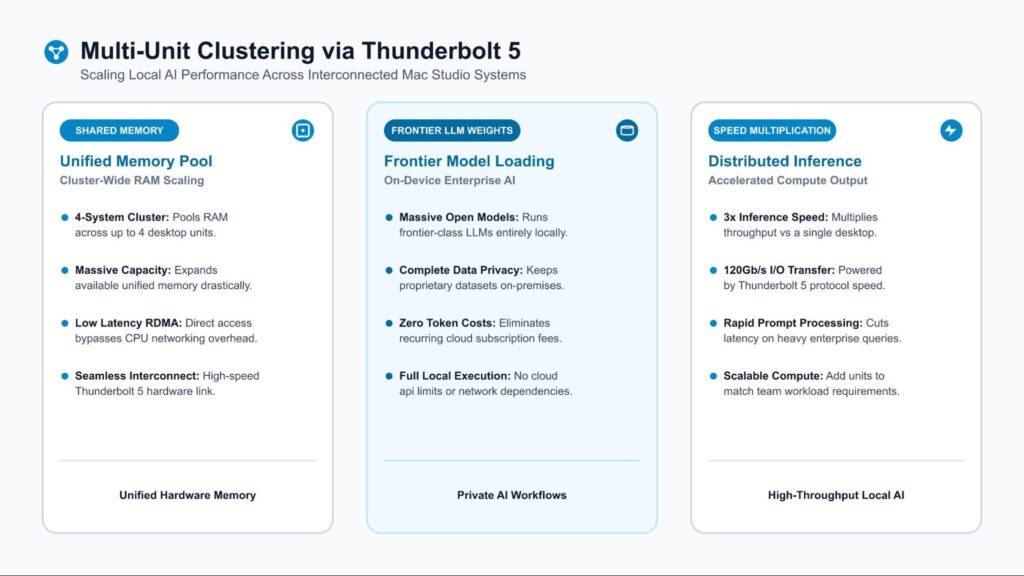
For research labs requiring even greater scale, multiple desktop units can connect via Thunderbolt 5 and Remote Direct Memory Access (RDMA). Interconnecting four systems forms a shared memory pool that delivers up to three times faster distributed AI inference performance than an isolated desktop.
Next-Generation Connectivity and System Features
Beyond internal processing, peripheral support and network connectivity receive notable upgrades:
- Thunderbolt 5 Integration: Provides up to 120Gb/s of total bandwidth for high-speed storage, external PCIe expansion chassis, and multi-display setups.
- N1 Wireless Chip: Introduces Wi-Fi 7 and Bluetooth 6, stabilizing high-bandwidth wireless network transfers.
- Display Engine Support: Drives up to eight independent displays, or up to four Studio Display XDR units at 5K resolution with 120Hz refresh rates.
- USB-C Genlock: Enables precise frame synchronization between display outputs and professional camera feeds.
Related Reading: 5 Tips and Tricks to Free Up Disk Space and Hidden Storage on Your Mac
The hardware runs on macOS 27 Golden Gate, utilizing updated developer frameworks like Core AI and MLX to streamline local machine learning deployment.
Developers can leverage Apple’s open-source machine learning framework, MLX on GitHub, to train and fine-tune models efficiently on Apple silicon.
Frequently Asked Questions
What is the base starting price for the M5 Mac Studio?
The Mac Studio with M5 Max starts at $2,499 ($2,299 for education), while the M5 Ultra configuration starts at $5,499 ($5,099 for education).
How much unified memory can the M5 Ultra support?
The M5 Ultra configuration supports up to 512GB of high-bandwidth unified memory operating at speeds up to 1.2TB/s.
Can you cluster multiple Mac Studio systems together?
Yes, using built-in Thunderbolt 5 and RDMA support, users can cluster up to four systems together to share memory and accelerate AI inference up to 3x faster.
The Bottom Line
The Mac Studio M5 performance leap establishes a high baseline for desktop workstations, particularly in local AI computation and heavy graphics workflows. By pairing GPU Neural Accelerators with up to 512GB of unified memory and Thunderbolt 5 connectivity, Apple offers creative professionals and developers a self-contained local alternative to cloud-based processing networks.
Source: Apple. Read the original article.
Related reading on blingspark.com: Which browser uses less RAM on Mac?; Why And How to Darken Text on Computer Screen.